|
|||

|
|||
|
||||||
|
|
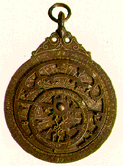
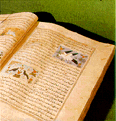
THE GOLDEN AGEThe early 'Abbasids were also fortunate in the caliber of their caliphs, especially after Harun al-Rashid came to the caliphate in 786. His reign is now the most famous in the annals of the 'Abbasids - partly because of the fictional role given him in The Thousand and One Nights (portions of which probably date from his reign), but also because his reign and those of his immediate successors marked the high point of the 'Abbasid period. As the Arab chronicles put it, Harun al-Rashid ruled when the world was young, a felicitous description of what in later times has come to be called the Golden Age of Islam. The Golden Age was a period of unrivaled intellectual activity in all fields: science, technology, and (as a result of intensive study of the Islamic faith) literature - particularly biography, history, and linguistics. Scholars, for example, in collecting and reexamining the hadith, or "traditions" - the sayings and actions of the Prophet - compiled immense biographical detail about the Prophet and other information, historic and linguistic, about the Prophet's era. This led to such memorable works as Sirat Rasul Allah, the "Life of the Messenger of God," by Ibn Ishaq, later revised by Ibn Hisham; one of the earliest Arabic historical works, it was a key source of information about the Prophet's life and also a model for other important works of history such as al-Tabari's Annals of the Apostles and the Kings and his massive commentary on the Quran. 'Abbasid writers also developed new a genres of literature such as adab, the embodiment of sensible counsel, sometimes in the form of animal fables; a typical example is Kalilah wa-Dimnah, translated by Ibn al-Muqaffa' from a Pahlavi version of an Indian work. Writers of this period also studied tribal traditions and wrote the first systematic Arabic grammars. During the Golden Age Muslim scholars also made important and original contributions to mathematics, astronomy, medicine, and chemistry. They collected and corrected previous astronomical data, built the world's first observatory, and developed the astrolabe, an instrument that was once called "a mathematical jewel." In medicine they experimented with diet, drugs, surgery, and anatomy, and in chemistry, an outgrowth of alchemy, isolated and studied a wide variety of minerals and compounds. Important advances in agriculture were also made in the Golden Age. The 'Abbasids preserved and improved the ancient network of wells, underground canals, and waterwheels, introduced new breeds of livestock, hastened the spread of cotton, and, from the Chinese, learned the art of making paper, a key to the revival of learning in Europe in the Middle Ages. The Golden Age also, little by little, transformed the diet of medieval Europe by introducing such plants as plums, artichokes, apricots, cauliflower, celery, fennel, squash, pumpkins, and eggplant, as well as rice, sorghum, new strains of wheat, the date palm, and sugarcane.
Al-Mamun died in 833, in the town of Tarsus, and was succeeded by his brother, al-Mu'tasim, under whose rule the symptoms of decline that had manifested themselves earlier grew steadily worse. As he could no longer rely on the loyalty of his army, al-Mu'tasim recruited an army of Turks from Transoxania and Turkestan. It was a necessary step, but its outcome was dominance of the caliphate by its own praetorian guard. In the years following 861, the Turks made and unmade rulers at will, a trend that accelerated the decline of the central authority. Although the religious authority of the 'Abbasid caliphate remained unchallenged, the next four centuries saw political power dispersed among a large number of independent states: Tahirids, Saffarids, Samanids, Buwayhids, Ziyarids, and Ghaznavids in the east; Hamdanids in Syria and northern Mesopotamia; and Tulunids, Ikhshidids, and Fatimids in Egypt.
|
| qardhaawi@qardhaawi.com Designed and Operated by Qardhaawi Graphic and Webdesign |





 Many of the advances in science, literature, and trade which took place during the Golden Age of the 'Abbasids and which would provide the impetus for the European Renaissance reached their flowering during the caliphate of al-Mamun, son of Harun al-Rashid and perhaps the greatest of all the 'Abbasids. But politically the signs of decay were already becoming evident. The province of Ifriqiyah - North Africa west of Libya and east of Morocco - had fallen away from 'Abbasid control during the reign of Harun al-Rashid, and under al-Mamun other provinces soon broke loose also. When, for example, al-Mamun marched from Khorasan to Baghdad, he left a trusted general named Tahir ibn al-Husayn in charge of the eastern province. Tahir asserted his independence of the central government by omitting mention of the caliph's name in the mosque on Friday and by striking his own coins - acts which became the standard ways of expressing political independence. From 821 onward Tahir and his descendants ruled Khorasan as an independent state, with the tacit consent of the 'Abbasids.
  Some of these states made important contributions to Islamic culture. Under the Samanids, the Persian language, written in the Arabic alphabet, first reached the level of a literary language and poets like Rudaki, Daqiqi, and Firdausi flourished. The Ghaznavids patronized al-Biruni, one of the greatest and most original scholars of medival Islam, and the Hamdanids, a purely Arab dynasty, patronized such poets as al-Mutanabbi and philosophers like the great al-Farabi, whose work kept the flame of Arab culture alive in a difficult period. But in historical terms, only the Fatimids rivaled the preceding dynasties.